Showing posts with label adaptation. Show all posts

Wednesday, June 18, 2008

Insider Secrets: Learning a New Language

When I was in Dallas last month, a friend asked me my secrets of learning a new language. His question made me laugh. As if. . .


. . . as if! Well, the subject of language learning would be fodder for 50 blogs, I dare say. First, there's the Russian language school in Vermont where I studied summer of 1998. It was a total immersion language school which means, that a person is, well, surrounded by nothing but the new language. In fact, if we spoke anything other than Russian on campus during the eight weeks, we were threatened with expulsion. Lucky for me, I had a car there and managed to get off campus quite regularly. That helped because for me, total immersion was an understatement. I'd say drowning would be more accurate.

Another topic would be statements that I've made in Russian, saying something quite different from what I had intended. Claiming, for instance, that I worked at the circus - simply because the Russian word for circus is so similar to the word for church. Oh yes, this topic could go on at length. But don't run off, please (that's to say, пожалуйста), dear blog reader don't flee just yet, I have no intention of inflicting that sort of torture on anybody. But I digress. Where were we?

Oh yes, language learning. I do know a thing or two about that. I may have purchased, as a matter of fact, nearly every Russian language learning tool published between 1996 and 2000. Perhaps I exaggerate. Perhaps not. Cassettes, flash cards, books on culture, dictionaries -- pocket-sized to 5-pounders. That was before I even moved to Russia. Then one day it occurred to me that the information in those books would not enter my brain by simple osmosis. Having them on a shelf within 15 feet of my skull wouldn't cut it. I had to open them, live in them and digest them. Oh yum.

Still, there are a couple of techniques that have made a difference for me. One is using a white board for vocabulary drills, 15 minutes morning and evening. What vocabulary? I like to keep an index card handy to jot down new words that I encounter. And then come home, look them up and expand on those words. Like if it's a noun, influence for example. Enlarge that to include the adjective and verb forms, influencial, to influence and such.

Another source of words for drilling is Vis-Ed, a company based in Springfield, Ohio which produces language learning cards. These are pocket-sized cards, maybe 1 .5 by 3-inches and printed with vocabulary words. The set has 1000 cards. Drilling with those is useful. And carrying them in a pocket or purse, just to pull out or look at in odd moments - waiting for the tram or walking along.

I need to insert a photo here, don't I? You're wanting to have a look at these cards, are you not, dear blog reader? Okay, I'll do that sometime. Only thing is right now I need to be getting ready. . . need to be heading off to the circus by 9:15. Oh my, did I say circus? Well, you know what I meant, didn't you?

Saturday, February 09, 2008

What Would Condi Do?

Condoleezza Rice, U.S. Secretary of State with Victor Yushchenko, President of Ukraine. (Photo courtesy of Yahoo!)


One snowy afternoon in January, I took the tram across town to my former neighborhood and went to the post office to renew my P.O. box there. While waiting in line, I watched for the young clerk with whom I had butted heads almost two weeks earlier.

I would recognize her immediately. She was taller than average, streaky blond and loud. After finishing my business, I waited in the lobby area in hopes that she would come along. Sure enough, soon she emerged from a back room and strolled through the lobby, heading outside for a smoke.

As she came toward the door, I caught her eye.

I need to talk with you for a minute. Last time I was here, we had an unpleasant conversation and I was impatient with you. Forgive me please.

Oh it wasn’t all that bad, she shrugged.

That’s one thing I love about Russian folk. They’re so quick to forgive.

And that was that.

Back out on the street, I felt such relief.

That feeling was so different from how I’d felt ten days or so earlier after our confrontation. That day, I kept asking myself, how would Condoleezza Rice have handled all that?

That had been my third trip across town to renew said post office box. The first two times, one clerk or another said something like, Oh come back another day. It’s only 30 minutes until closing time and we really don’t want to haul out that paperwork again.

I probably said something such as, Well, it’s not all that easy for me to get here. I live in another neighborhood now and so it’s not as though I live around the corner.

But I did come back again the third time and was making progress. I waited dutifully in the fill-out-the-renewal form line and the clerk there – to her credit – went far beyond her duties, helping me with the paperwork. Next, in the pay-for-the-box line, when I got to the front, my progress came to a screeching halt.

You’ll need to come back another day. I’ve already put away that stuff. Come back tomorrow.

So I explained that we’ve been through this before and all this was quite unnecessary. That it really would not be hard to take my rubles, write me out a receipt and stamp it in five places to make all official as they’re wont to do here.

The clerk was pleasant enough but she shrugged and turned to the next person. During our conversation, a teenage clerk was standing at the other end of the service counter with a gaggle of her clerk buddies.

She’s American isn’t she? she asked just loud enough for all to hear.

Next time, I’ll just ignore that.

Yes I am. And at least in America there is decent customer service.

Next time, I'll direct my best withering gaze in her direction. (Note to self: Start practicing this look in the bathroom mirror.)

So there was a little back and forth between us there, mostly her laughing with her friends. As I started to leave, I decided it was time for some eyeball-to-eyeball conversation with the Miss Mouthy and headed in her direction. She saw me coming, let out a loud shriek of laughter and fled to the back room.

Is your friend okay? I asked her co-worker. Was she was laughing at me?

Oh of course she’s fine. No, of course she wasn’t laughing at you. We were laughing about. . . about something here in the newspaper.
She motioned to the tabloid open there on the counter.

That’s a typical response. People can lie in a heartbeat, without blinking an eye.

So I left and felt pretty good about all that for about 30 seconds but then it dawned on me that I’m the first American many of the other customers have ever encountered. And while it may be true that most of them would have a complaint or two about customer service, I was uncomfortable with the tone of our conversation.

How would Condoleezza Rice have handled that? Her diplomacy and grace come to mind quite often. It doesn’t hurt that she specializes in Soviet studies and is said to speak fluent Russian.

* * * * *

We learn a lot about ourselves when immersed in another culture. We see how we handle stress of smashed expectations. We see how we deal with the frustration of communicating at a child’s level. Cross-cultural living is a magnificent growth opportunity. But only if we use it as such.

After an unpleasant incident, it’s important to mull it over, ruminate on it and analyze it. First, what happened? How did I feel about what happened? How did I respond to what happened? How will I handle it differently next time?

I have no control over the twerpy behavior of a 17-year-old postal worker. But I do have control over myself. As long as there aren’t any sweets involved, that is. I can choose to ignore a verbal jab. Or I can respond with humor.

So, let’s rewind the whole scene.

She’s an American, isn’t she?

You’re close. Actually I’m from Antarctica. And believe me, your customer service here is far superior.

Who knows, Condoleezza Rice might be so impressed with such diplomacy that, in an historic move, she would appoint me first U.S. Ambassador to Antarctica. No lines and no waiting for that job!

Monday, September 17, 2007

The Light's Off. . . but Everybody's Home


Attention engineers and inventors: We need a way to stockpile electricity for home use. We already squirrel away canisters of water for those hours or days when there’s no water, a regular occurrence around here. But when the electricity is off, a flashlight helps out although most folks have candles handy.

As I write this, we’ve got 2 hours until lights go off at 5:00 p.m. At least today I’ll not be surprised when everything goes dark.

But Sunday morning when I was in the midst of my getting-ready-for-church beauty-wanna-be regime, when my curling iron and I had almost persuaded my hair to curl, that’s when the big, fancy refrigerator six inches from my elbow shuddered, sighed and went silent. Not everybody does her hair next to a refrigerator, of course, but here where my living room is an extension of the kitchen – so the refrig is there– and my hallway is an extension of the bathroom – so the mirror is there near the outlet, that’s the set-up.

So with the curling iron cooling, by the time I had checked my electrical breaker box, it was on to Plan B for the hair. Knowing that if my electricity were out, the other 35 apartments in this stairwell were probably also in the dark. I figured that someone would have it all worked out by afternoon when I would be back from church. But alas and alack. Hours later when I unlocked the door, I was greeted by pitch black silence. No low hum of refrig. The place was quiet. Quieter than. . .than an early autumn breeze wafting ‘cross the steppe.

Russian folk express being without electricity as being without lights or bez svyeta. Svyet being light and the –a ending for genitive case because, according to the rules of Russian grammar, that which one lacks, she lacks in the genitive case. So here it was, a balmy autumn afternoon perfect for productivity and creativity and I was stuck in the genitive case.


* * * * *


After a nap, I went down to check with Galina on 1st floor. Those first floor folk are often good sources information. Sure enough, Galina had the scoop.

Maybe this evening we’ll have lights. But maybe not until day after tomorrow.

Oh nooo!

I was envisioning my stash of sweet peppers and pelmeni thawing and spoiling. I asked how she had all this information and I didn’t.

I read the notice posted by the door.

Oh. Ohhh! I get it – functional literacy! So I hurried outside to check the spot and sure enough – a notice was posted. (Note to self: Watch for notices, particularly those where either light or water is in the genitive.)

Around 5:00, I curled up in an armchair and read by a west window. I stewed about my stuff in the freezer: red and yellow peppers, packages of veggies, pelmeni, plum puree. . . I was thinking about calling a taxi to haul me and the semi-frozen stuff to the church building where there’s a freezer. Decisions, decisions.

Then I became very decisive when the vision of a Ritter Sport bar with almonds flashed through my mind. Heading downstairs toward the corner store, I passed two electricians working in the stairwell. Actually, one was working by the light of a cell phone held by his co-worker.

I have a flashlight if you’d like to use it.

Nyet, nyet, we’re fine, said Mr PhoneHolder.

Soon it was 8:00, past dusk and two more hours until bedtime. Didn’t Abraham Lincoln read at night by the light of . . . something?

Still considering my options: I wanted to work on my computer. I could take the laptop and walk 10 minutes to a café. But it's not a internet cafe, certainly not computer friendly. And besides, it would be noisy, smoky and uncomfortable. Or I could walk 25 minutes to the church building or pay like 100 rubles for a cab. . .but at 8:00 pm?

Mulling , mulling, mulling it over. . . what to do, what to do, pros and cons and not knowing if lights would come later in the evening or later in the week. What? What was that sound? I heard a low hum. Then I was heard the printer clank on in the next room. Oh yeah – those electricians came through and we had s-v-y-e-t!

Well, we had same dilemma the next day at 5:00 pm for three hours. And the following day as well. And they say we’re not outa the woods yet with repairs to the electricity.

So I was thinking that it comes down to two things, maybe three: decisions about food that could spoil. And decisions about having enough light for reading. And it would be nice to have the computer working during that time. So, there you have it, you inventors out there. What can you come up with for the rest of us?

Just to aid in your initial research: A quick Google search shows Online Consumer Reports with info about generators – looks as though a person could easily spend $2,000. Let me be more specific about the project: What could a person get for, say, for $100? That is, other than several very nice flashlights and lots of batteries?

Tuesday, June 13, 2006

And What Are YOU Staring At?

I turned around and there were 16 pair of eyes on me. Conversation stopped, all were turned in my direction and gazing unabashedly.

I had stopped by the office of a particular foreign consulate and to my surprise, there were no lines at the service windows. The room was full of people waiting for their documents, however, and officials were busy in the back offices.

Eventually, an official came to the window and gave me his attention. I showed him my passport and began talking through the speaker. My explanation was in Russian, of course, but after two sentences he interrupted and said in English, "WHAT do you want."

He meant it as a question but I wasn’t sure what to think. His words sounded abrupt because of his emphasizing the WHAT and not raising the pitch of his voice at the end of the sentence. Nevertheless, I followed his lead and switched to English. Shortly he interrupted again and told me that I would need to speak with another official later. I doubt that he understood much of what I was saying.

Then when I turned from the window, every person in the waiting room was staring. They had overheard our conversation through the speaker, of course, and found it quite interesting. Just between you and me, I don’t relish being an object of curiosity, particularly when I’m trying to take care of personal business. But, welcome to Russia!

* * * * *

I had a similar experience recently at the bank when picking up funds. The teller was giving me instructions, all in Russian of course, about where to sign the various documents. She was speaking loudly enough that the entire room could overhear and then when she announced the grand cash total, I felt my mouth go dry.

“It wasn’t necessary to broadcast that to everyone.”

I looked around and other tellers had paused mid-task, customers had turned to look and even the security guard was staring in my direction.

* * * * *

And so you see, staring happens and it ranges from gawking at passersby on the street to curiosity about private transactions. I find it unnerving to be stared when I’m conducting personal business. The staring is only momentary, of course; gazes shift to another person or perhaps to a fly buzzing in the window. But after several uncomfortable staring incidents recently, I decided to that I must address this issue of staring. How to deal with it? Through understanding and through humor. As though that were easy. First, a Google search: staring and culture.

First, there were tips for a person from an Okay-to-stare culture being transplanted into the Australian culture:

“. . .it is extremely rude to openly and curiously look at someone you don’t know. . . Some Australians interpret this kind of looking behaviour, no matter how harmless it is intended to be, as an aggressive assault on their privacy and may even challenge you to a fight. When dealing with strangers, Australians try very hard to only glance and perhaps smile briefly at the stranger and then carefully avert their eyes.”

And then I found insight for the person from a Don’t Stare culture who finds herself unnerved in, say, Italy, Indonesia or. . .Russia.

“Remember, you are quite an unusual creature in this setting. Many people on the streets will have had little contact with foreigners. What you look like, what you do, and how you behave will generate intense interest. Don't get angry or try to "educate" people on the idea that staring is rude. It will only increase curiosity, and frustrate you. Relax. Let people look. After all, you are doing your own exploration of the people and places here. What you are reacting to is not so much the staring, but your cultural interpretation of the action”

Okay. I'm understanding staring a bit more. Now for some humor. How about I burst into song with “The Eyes of Russia Are upon You” to the tune of “The Eyes of Texas…,” and add a little soft-shoe shuffle. That would be sensational, especially when I pass a hat for contributions.

Sources: Website of the Indonesia Australia Language Foundation (www.ialf.edu). Different Pond, Different Fish. (March 2004.); India Web Site.Travel India: An Insider’s View. Cultural Pointers. (2005).

Monday, April 24, 2006

Face to Face with Vladimir Lenin

On a bright morning in early March, I had 10 hours to fill in Moscow and, like most visitors to the city, I headed directly to Red Square. St Basil’s Cathedral was exquisite in the early morning light and so, after photographing to my heart’s content and thawing my frozen fingers over a breakfast of tea and blini with a local friend at a quiet café, I headed toward Lenin’s Mausoleum, which overlooks the area.

Red Square is cordoned off in the mornings until the mausoleum closes at 1:00, we learned. That translates into walking about ten times farther than necessary to reach the entrance to the mausoleum. But that, dear comrades, is another story.

Lenin wanted to be buried next to his mother in St Petersburg, they say. It wasn’t his idea to be placed in a glass coffin, his mortal remains on public display for the next 80-plus years. But since his death in January of 1924, thousands have filed past the body of this man who so influenced the world.

Lines are considerably shorter nowadays and on the day of my visit, only handful of us were there. I was totally fine with that. Once inside the mausoleum, it was quiet, dark and chilled. The narrow corridor was lined with black, granite-like stone leading to the steps down into the tomb. In the semi-darkness, only the face of a soldier was visible and he stood under a single light at the end of the corridor. His gloved hand was held chest-high and pointed to the right. So I went that-a-way. At the end of that corridor was the same sight, an expressionless face lit by an overhead light, a gloved hand pointing right. So I shuffled along in the dark, trying to anticipate the steps.

What I saw next reminded me of a phrase of a beloved hymn, Low in the grave He lay. There was the body of Vladimir Illyich Lenin. Very quiet, still and cold. No surprise there. A walkway surrounds the glass sarcophagus on three sides and I paused to view the body that had been there for decades already. The face was almost translucent, like fine porcelain. A guard approached me.

Lady, you must keep moving.
Well, okay, I thought. But I’m the only one in here at the moment, save for those ever-so-watchful guards. I’ll keep moving but it will be slow enough that I can soak in details. See, a person can walk around that coffin in a heartbeat and that’s the end of it. From there,  another dark corridor leads outside. There are no displays and no memorabilia. No photographs and no plaques. All is very solemn, quiet and dignified. And very black.

I was itching to jot down the details quick-like before I forgot. I stepped out into the sunlight, reached for my notebook and started scribbling notes. I needed a place to sit and write. What better place than those stone benches that flank the mausoleum. Before brushing off the snow to sit down, I walked over to the guard for permission.
Nyet, he said semi-apologetically.
That’s understandable, I figured. Those are the review stands from which dignitaries watch official parades and such. But nobody was there; it wasn’t as though I would be taking anyone’s spot. But I understand. The place was to be sacred versus common.
So, how about if I just stand here and write, I bartered?
Nyet, you’ve got to keep moving.
All-righty then. I can walk verrry slowly and keep writing. As I neared the end of the review stands, another soldier there was watching. It was a slow day on Red Square and his full attention was on me.
Zdrast-vwee-tye, I greeted him formally and nodded. His eyes widened slightly, hearing a foreign accent.
Lady, why are you writing? What is it that's of interest to you here? He took at my notepad and I imagined he might confiscate it.
Everything is interesting. I want to remember all these details. And if I don’t write it down right away, I’ll forget it. I wanted to add, And furthermore, in about 30 years when you’re 50, you’ll understand perfectly.
Well, lady, you must remember what you see and write it down after you leave. You may not write while you’re here.
Welcome to modern Russia, I said with more of a smile than I felt.
Da, he chuckled. Welcome to modern Russia.

* * * * *

How about you, dear Blog Reader, have you visited Lenin's Mausoleum? Please do share. . .


Tuesday, February 21, 2006


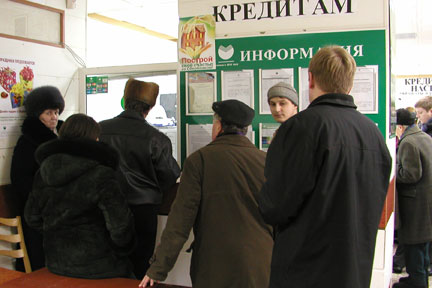
The Queue at the Bank

The Etiquette of the Queue

I joined the queue at the bank and congratulated myself for being third in line. It was sure to go fast. Normally we would be using the ATM on the street, but it freezes up in the winter and so we were using a window inside. After 15 minutes, however, we were no closer to the teller and the line was even longer.

Two young men in line behind me seemed to know each other.

"Let's go have a smoke," one said.

When they returned, the guys wanted back their places in line. But first they had to persuade the blond in the cream coat to let them in. After some fussing, she complied but she began a campaign of complaining about the slow service.

The two guys were talking louder now and aiming their remarks at the lady who was first in line. She was wrapped in mink from hat to hemline and had buddied up with lady #2, clad in a cotton coat, scarf knotted under her chin. Lady Mink stayed cool despite the on-going comments from the line and kept signing the long slips of paper that the teller pushed to her through the sliding tray.

"All this waiting for ten rubles, her whole pension," quipped one guy loud enough for all to hear. Her check would be pocket change is what he was saying.

Mrs. Mink didn't look up; she just kept signing her papers.

This wasn't the first time I had observed issues of the queue. Two summers ago, I was 6th or 7th in line, in this very line. As we inched forward, a couple of babyshkas, Russian grandmothers, charged up to the head of the line.

"We're next," they announced. "We've been waiting and we're next."

Actually, they had been resting in chairs along the wall. It's not uncommon here to step out of line to rest or to run another errand. Someone might be in line at the bank, at least in theory, while they are actually at the post office. When they return to the bank 10-15 minutes later, they want their spot back. Those waiting usually accommodate the multi-tasker with a sigh of resignation. But for me, the situation calls for more than a sigh. Perhaps it's all those years of teaching school and monitoring lunch lines, perhaps it's my fondness for etiquette or perhaps it's a reflection of my own culture where one waits in line or loses the spot. So, although I'm learning to be diplomatic about it, I do tend to verbalize displeasure at being pushed back in line. Rarely do I hear anyone else expressing annoyance about this or anything else for that matter.

That summer's day, however, I saw the Russian queue in a new light. The young people in spots 2, 3 and 4 weren't in the mood to be pushed back and they weren't budging. They were standing tight and close.

When the babyshkas got louder, the young security guard came over to investigate. He was blond, boyish and hesitant to get involved. He understood that Russian babyshkas are not timid souls. Chances are he had dealt with a babyshka of his own.

So he tried using persuasion. "Please, people. Please let these grandmothers get in line."

No one moved.

"You've got to let me in line. I'm a hero of the Great Patriotic War!" cried one. With that, she was playing her trump card. Being a war hero has its privileges, which include going to the head of a line and getting a seat on the bus. In theory, at least.

The young woman in spot #2 wasn't impressed.

"Check her documents," she countered. "She's probably just saying that."

Lady #3 had stories of her own. "Well, I've suffered too. My father perished in the war and I was orphaned. Besides that, I had a heart attack last week."

I was rather enjoying the conversation around me. For once I was not involved in upgrading the behavior of the queue.

Another babyshka shuffled into the bank and joined me at the end of the line. She smiled shyly.

"Won't you please allow me ahead of you? I won't take long. And my health isn't so good."

"With pleasure," I said, surprising myself at what a softy I had become.

The security guard overheard our little chat and recognized it as fodder a persuasive speech. He headed back to the front of the line where things were quieter although no one had given in just yet.

"Ladies, there's a foreigner here who was kind enough to let one of our babyshkas in front of her. Let's follow example of this foreigner and be kind to our own elderly."

Oddly enough, I don't remember how things turned out that day at the bank. But I do know that the etiquette of the queue continutes to challenge me as I adjust to Russian life. It's a culture which itself is in transition as younger people are more willing to be assertive and nudge public interaction to a higher level.

So, think you're next in line? You might be. Then again, if you happen to be in this neighborhood, don't bank on it.

Tuesday, January 31, 2006

A Russian Winter to Write Home About

Today is a tropical 20 degrees F in comparison to last week’s severe cold of –20 here in Rostov-on-Don. The cold snap was the coldest weather in a generation for Russia and Eastern Europe. Weathering the bitter cold requires some adjustment and for me, that includes cutting back on iced tea. I pooh-pooh the local notion that drinking anything cold is an invitation to getting sick.

There’s no arguing that Russians know how to winter. They’ve won wars with their wintering skills. They froze out Napoleon and out-wintered Hitler. The Russian proverb, “There’s no such thing as bad weather, only bad clothing,” reflects their philosophy that if one is dressed right, weather can be managed. And so now on the street we see magnificent full-length fur coats and beaver skin hats which have been stuffed into closets during recent warmer winters.

My own coat, a sleeping-bag style in cardinal red, is a marvel of apparel functionality thanks to Eddie Bauer and Co. It’s guaranteed good to -40 F, weighs kilograms less than a heavy fur and is not a coat likely to be stolen from a coat rack. So I’m plenty toasty outdoors but keeping warm indoors has been quite another story. I’ve finally figured out that wearing not one but two layers of thermals makes a difference, as does wearing a knit hat and fingerless gloves.

Granted, my place has been colder than most. In mid-December when I returned from a 12-week furlough, I was more interested in unpacking than in weather-stripping and rationalized about the merits of not sealing off my two balconies, just this once. I figured that the north balcony would be a great walk-in refrigerator-freezer, ideal for cooling off the big batches of soup that I make regularly and then leaving the south balcony unsealed would allow me to shake my throw rugs over the railing rather than lugging them down the elevator to shake them at ground level. Besides that, I was out of the foamy lengths of weather-stripping.


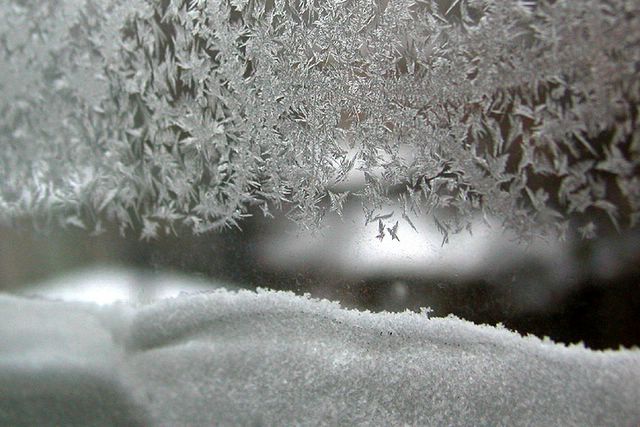
Frost Inside My Kitchen Window

Suffice it to say, it got a little nippy in this apartment with cold air sneaking in from both the north and south, converging around my favorite easy chair. It’s lots warmer now since our brother Nickolai came over with weather stripping and heavy plastic sheeting which he tacked around the outside of the balcony doors and windows. But in the meantime I got an upper respiratory infection that kept me home several days.

Russian folk have their ways of coping with the cold. Electric space heaters are common as is keeping gas burners on the stovetop going. And then there’s the drinking of hard liquor. Alcohol consumption surged in Moscow last week and in a town further north, an elephant went bezerk and ripped his cage apart after zookeepers fed it a bucket of vodka to help it feel warmer, according to Fred Weir of The Christian Science Monitor.

As for me, with the temperatures for the next five days surging above 0 degrees F, I’m back to enjoying my home-brewed iced tea with plenty of ice. Cheers!

Monday, January 16, 2006

Frigid Temps Bring Special Beauty

Greetings from Rostov-on-Don, Russia where frigid temperatures bring us special beauty. Ice collects inside windows in intricate fern or paisley shapes, as though etched by Father Frost himself. But the cold temperatures failed to discourage the holiday version of trick-or-treaters who came by for Orthodox Christmas, Jan 7th, singing silly songs and begging for candy. Fortunately, they’re equally thrilled to quarters, nickels and dimes from this Amerikanka.


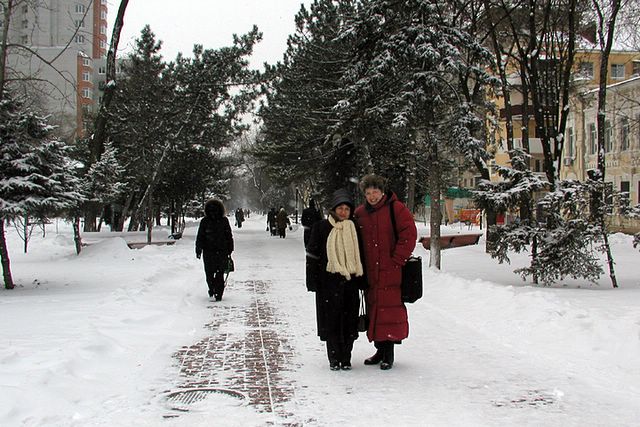
Pyshkinskaya Boulevard on a January Sunday.